
Federated Computing
As organisations increasingly recognise the limitations of working with isolated datasets, there is a growing need for data collaboration. However, this is often constrained by regulatory requirements, privacy concerns, and operational challenges that restrict the centralisation of sensitive data.
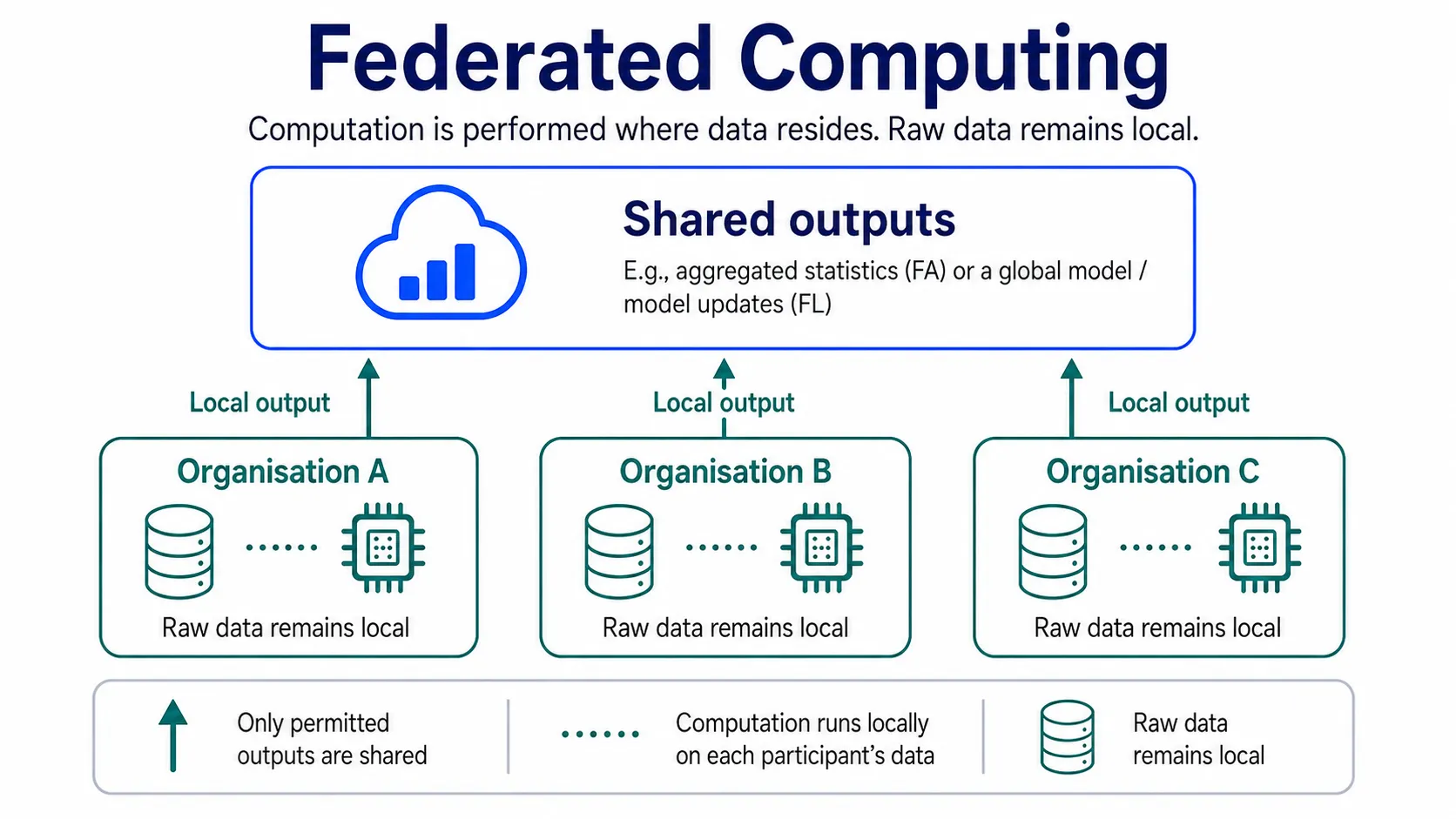
Federated approaches address these challenges by enabling organisations to collaborate on data-driven insights without transferring raw data across organisational boundaries. Instead of moving data to a central repository, computation is brought to where the data resides. Only derived outputs, such as aggregated statistics or model updates, are shared across participants. This reduces data exposure while still enabling meaningful collaboration.
This federated approach encompasses two complementary capabilities:
Federated Analytics (FA) enables organisations to perform distributed statistical analysis across multiple data sources. Analytical queries are executed locally at each participant, and only aggregated results are shared. This allows organisations to generate insights such as counts, averages, trends, and correlations without centralising raw data. In practice, FA also supports essential preliminary activities (e.g., data discovery, quality assessment, harmonisation) prior to Federated Learning.
Federated Learning (FL) extends this concept to collaborative machine learning. Instead of sharing data, participants train models locally and exchange model updates (e.g., parameters or gradients), which are aggregated to form a shared global model. This enables the development of predictive models across distributed datasets while keeping sensitive data local.