
Optional Extension: Secure Entity Alignment for Vertical FL
The main path in this guide assumes horizontal FL, where participants have similar feature spaces but different records. Some use cases require vertical FL, where participants hold different features about overlapping entities. In those cases, the parties must first determine which records overlap without revealing their entire datasets to one another.
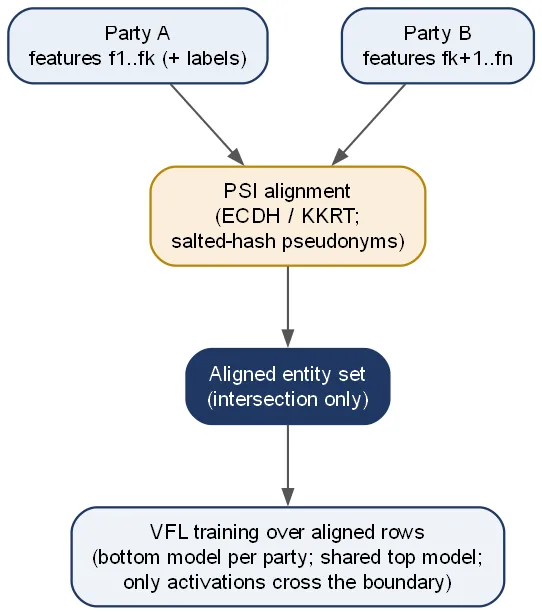
Figure 6. Example secure entity alignment flow for VFL. Parties align entities through PSI and train only over the aligned set.
8.1 When this applies
Section titled “8.1 When this applies”| Question | Guidance |
|---|---|
| When is entity alignment needed? | When participants need to train on overlapping entities but hold different feature sets. |
| What identifiers may be used? | Use the minimum necessary identifiers and apply identifier hygiene before matching. Avoid casual use of direct identifiers where safer alternatives exist. |
| Should this be in the main tutorial? | Only if the repository has a working and tested PSI module. Otherwise, present it as an advanced extension. |
8.2 Identifier hygiene
Section titled “8.2 Identifier hygiene”-
Use only identifiers approved for the matching purpose.
-
Normalise identifiers consistently before matching, for example trimming, casing, format checks, or salt handling where applicable.
-
Avoid retaining raw identifiers in logs or exported artefacts.
-
Record the approved purpose, participants, matching date, and match-count outputs.
8.3 PSI approach and execution
Section titled “8.3 PSI approach and execution”Private Set Intersection (PSI) is a common approach for privacy-preserving entity alignment. The exact protocol should be selected based on the repository implementation, participant capabilities, identifier sensitivity, and performance requirements.
| Step | Operator action |
|---|---|
| Prepare identifiers | Confirm approval, normalise locally, and validate format. |
| Run PSI protocol | Execute the approved PSI runner, such as ECDH-PSI or KKRT where supported. |
| Review match counts | Check whether overlap is sufficient for the VFL task. |
| Approve aligned set | Record governance decision for using the aligned entity set. |
| Proceed to VFL training | Train only over approved aligned records and log the protocol output. |
8.4 Audit and evidence
Section titled “8.4 Audit and evidence”| Evidence | Why it matters |
|---|---|
| Protocol and version | Supports reproducibility and security review. |
| Participants and purpose | Shows that alignment was performed only for an approved collaboration. |
| Identifier preparation method | Documents normalisation and hygiene steps. |
| Match counts and error conditions | Shows whether the aligned set is viable. |
| Approval decision | Shows whether aligned outputs may be used for training. |
8.5 Failure modes
Section titled “8.5 Failure modes”| Failure mode | Response |
|---|---|
| Low overlap | Review whether the VFL use case remains viable or should be redesigned. |
| Unexpected high overlap | Check identifier preparation and whether matching inputs were correct. |
| Protocol failure | Inspect local logs, participant configuration, and version compatibility. |
| Identifier-quality issue | Fix local identifier preparation before re-running alignment. |
| Governance objection | Do not proceed until the participant agreement and approval basis are resolved. |