
Overview
Welcome to the AI Privacy publication. As Artificial Intelligence (AI) reshapes how we build and interact with digital services, ensuring the privacy of the data that fuels these systems has never been more critical. Privacy risks in AI do not exist in a vacuum; they permeate the entire lifecycle. These vulnerabilities arise sequentially and cumulatively: from the personal information embedded in the Data Layer, to the mathematical memorisation and exposure of that data within the Model Layer, and finally through the user interactions, inferences, and interface vulnerabilities at the Application Layer.
Privacy Risks across the AI Lifecycle
Section titled “Privacy Risks across the AI Lifecycle”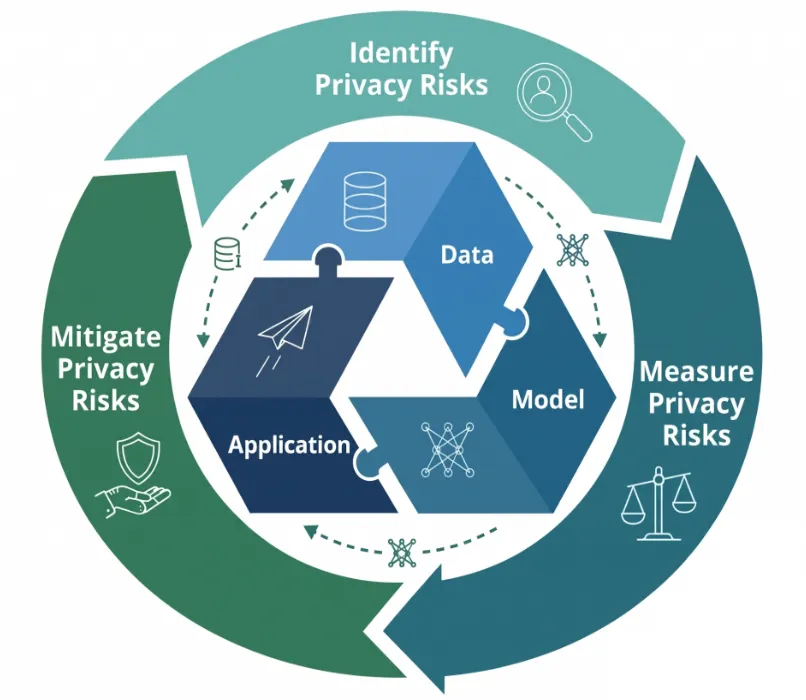
Identify, measure and mitigate privacy risks across AI Lifecycle.
To help you navigate this complex landscape, this publication provides a structured guide for identifying, measuring, and mitigating privacy risks across three critical layers:
- Data Layer: Sourcing and storage of training data
- Model Layer: Training processes and learned parameters
- Application Layer: Deployment, inference, and user interaction
Each layer is examined through three actionable lenses:
- Identify Privacy Risks: Understanding where and how privacy vulnerabilities manifest across the AI lifecycle.
- Measure Privacy Risks: Quantifying privacy risks through rigorous testing and evaluation methods at each layer.
- Mitigate Privacy Risks: Applying targeted, engineered interventions to address vulnerabilities at their source.
Understanding these vulnerabilities is the crucial first step in building responsible, privacy-preserving AI systems. To drive real-world impact, we need to move from identifying risks to actively quantifying and then mitigating them.
Privacy in the Responsible AI Landscape
Section titled “Privacy in the Responsible AI Landscape”Privacy is one of six pillars that together form the foundation of Responsible AI. The six principles that AI systems should strive towards are as follows:
- Privacy: AI systems should handle personal data carefully and protect against potential data leakages (the focus of this publication).
- Safety: AI systems should be (i) protected against adversarial threats and misuse for harmful activities and (ii) aligned to the public good.
- Robustness: AI systems should perform up to task even when subjected to challenging requirements or circumstances.
- Fairness: AI systems should strive to be fair and equitable to all, regardless of gender, race, religion, or other attributes.
- Explainability: AI systems should provide clear and reliable explanations for their automated decisions to key stakeholders.
- Transparency: AI systems should document key development and deployment choices and be clear about how the AI system should be used.
💡 Explore the other pillars: Check out the AI Practice team’s Responsible AI Playbook to learn about building responsible AI systems in the lens of the other pillars.
📝 Note: This publication is a living document. As the field of privacy-preserving AI rapidly evolves, we will continue to update it to reflect the latest developments. We hope it proves useful for your work, and we welcome your feedback as we refine it further.