
Pann Lim: Event Summary at GovTech
Introduction.
Section titled “Introduction.”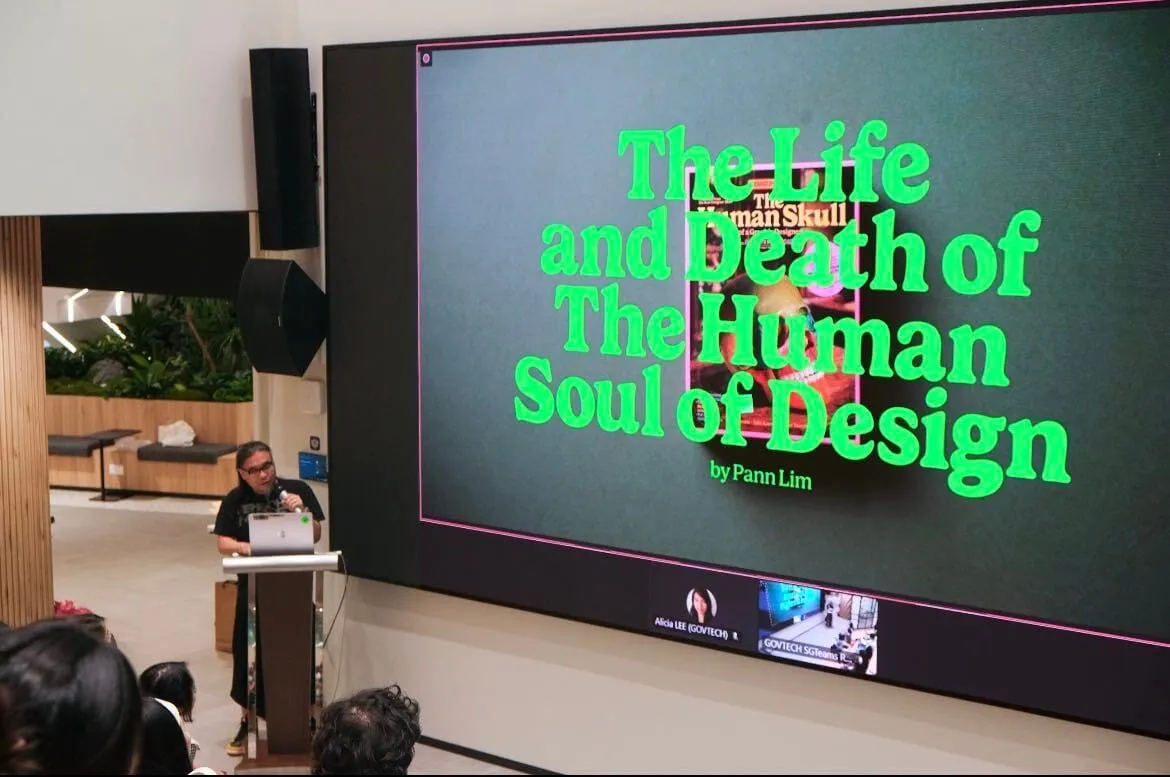
Pann Lim speaks on his research, The Life and Death of the Human Soul of Design at GovTech.
What does a 28-year veteran of the creative industry believe it takes to stay relevant in the age of AI? Pann Lim, co-founder and Creative Director of award-winning Singapore studio Kinetic, has watched design survive big shifts before. But when AI arrived, students and parents began writing to him on whether the field was worth pursuing at all. And so at 53, he went back to school to find an answer. Pann speaks as a designer but the worry isn’t design’s alone. As AI starts to assist with writing code, drafting specs and generating design concepts, the same question echoes across professions: how will our roles evolve, and how do I stay relevant?
Craft, a Human Act.
Section titled “Craft, a Human Act.”Blink once and the next generation of AI will have taken shape, which is why, when Pann began his thesis research, he chose to study the constant rather than the variable: No matter how far AI goes, what will stay human? What qualities in our work can AI not replicate?
The 11 Dimensions of the Human Soul.
Section titled “The 11 Dimensions of the Human Soul.”Reflecting on 28 years of experience, from work that won awards to work that won people over, Pann landed on a framework to help answer those questions: the 11 Dimensions of the Human Soul of Design.
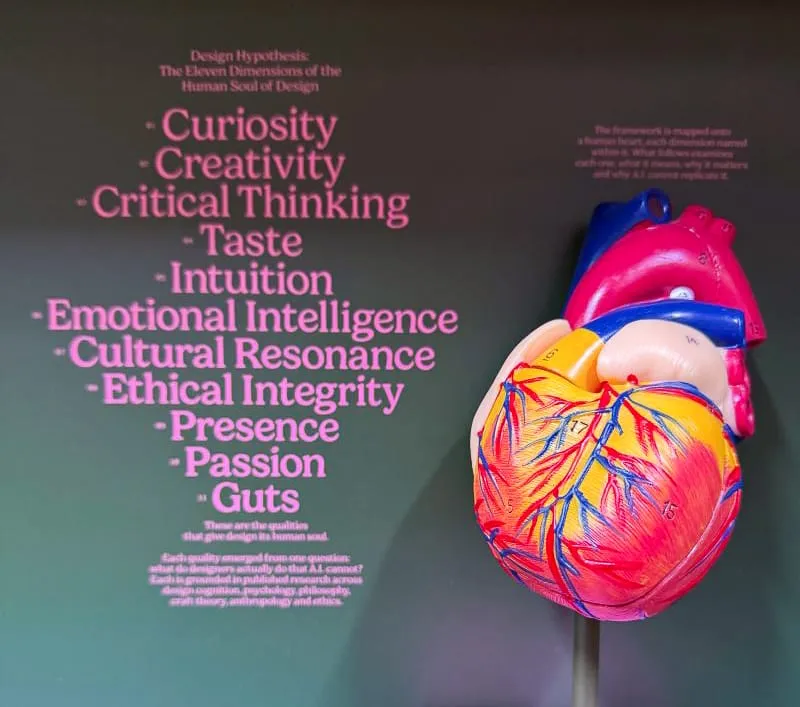
The 11 Dimensions of the Human Soul, displayed at Pann’s exhibit at Basheer Graphics Books in August 2026. Image from LinkedIn.
The following are 6 of the 11 dimensions explained:
| Dimension | What Humans Bring | Where AI falls short | |
|---|---|---|---|
| 01 | Curiosity | Humans ask “why” and “what if” without being told to. We wander, notice what others miss and chase questions for their own sake. | AI answers the questions we give it, but never digs to ask more, let alone, asks its own. |
| 02 | Creativity | Humans can judge whether an idea fits the context, and whether the ideas are original and fresh. | The extent of AI’s creativity is that it creates, and it creates endlessly. |
| 04 | Taste | Humans build a sense of what is right, beautiful and appropriate through years of looking, making and comparing. | AI can copy popular styles, but cannot tell whether a style suits the work. Left to itself, its work ends up looking like everything else. |
| 07 | Cultural Resonance | Humans live inside a culture, including its beliefs, habits and symbols. This shared context is what allows humans to spot the subtle details that make a piece of work feel deeply personal. | AI can catalogue a culture as data, but has never lived in one. It can’t sense the subtle details that turn ordinary work into something that truly resonates. |
| 08 | Ethical Integrity | Humans weigh how a decision could help or harm, and take responsibility for the outcome, even when a shortcut is available. | AI can carry out tasks, but cannot judge whether a task should be done at all. |
| 11 | Guts | Humans commit to ideas that might fail, knowing their name and reputation are on the line. | AI generates without risk. With nothing to lose and no consequences to face, AI never needs courage. |
Note: The explanations above are our own interpretation of Pann’s framework. These six offer a preview. The full framework includes critical thinking, intuition, emotional intelligence, presence, and passion.
Pann is clear that the 11 are not a rigid checklist—they work as a shared language where meaning comes from how they combine. Yet the ingredient Pann values most sits outside the 11. It can’t be taught, and it can’t be prompted.
The Wild Card: Serendipity.
Section titled “The Wild Card: Serendipity.”Serendipity is finding something valuable by chance, while looking for something else. Pann likens it to drawing a wild card in Uno: you can’t choose when the card lands in your hand, and no amount of practice makes you luckier. But practice decides whether you know how to play the card when it arrives. The 11 dimensions are the skills you build through that practice; Serendipity is the unexpected moment that changes the game.
Pann illustrated the wild card with his own projects. To show how it plays out beyond the studio, we’ve chosen three examples of our own. In each, a moment of Serendipity met a human dimension and created something new:
Why AI Can’t Draw the Wild Card.
Section titled “Why AI Can’t Draw the Wild Card.”For Pann, Serendipity arrives through lived experiences: the memories, frustrations, and feelings that make an accident mean something. Accidents happened by chance, lived experience made the moment matter, and the human dimension directed an idea.
| Dimension | What Lived Experiences Provide | In Real Life | |
|---|---|---|---|
| 01 | Curiosity | A reason to care | Fleming had watched soldiers die from infected wounds in WWI, so a dish of dead bacteria carried deep personal meaning. |
| 02 | Creativity | Something to connect to the accident | Fry kept losing his place in his hymn book, giving a forgotten glue experiment an immediate purpose. |
| 11 | Guts | Reputation and capital on the line | Stewart Butterfield and team faced public failure, but had the courage to stake their remaining capital in a new direction. |
AI has no memories to recall and no frustrations to feel. It has no reason to care, nothing personal to connect, and no real consequences to face. Because AI can only synthesize existing data without living through it, serendipity remains—in Pann’s words—a purely human play.
“Designers do not think only with their heads. We think with our hearts.”
The Human Remains.
Section titled “The Human Remains.”The fear of being replaced isn’t new. Photography threatened the painter, phototypesetting disrupted the hand-letterer, and Excel upended the estimator. Each time, humans have come out the other side with new skills and new ways of thinking.
But Pann sees a break in the pattern:
“A pencil does not draw by itself.
A camera does not compose on its own.
A Mac does not design on its own.“
Every tool before AI waited for the human to tell it what to do. This time, humans wait for AI to create. Somewhere along the way, Pann notes, someone else starts doing the authoring for us.
GovTechies were surveyed on their use of AI before the speaker’s event.
When a tool can author, we rarely hand over our soul in one go. More often, we lose it by habit. Reaching for AI becomes the first move, even when the answer is already within us, and each shortcut skips a little of our own thinking. The lesson isn’t to avoid AI. In fact, it’s here to stay, and can be used to complement our work. Use it, but notice when it stops helping, or starts doing the thinking that should be ours. If a tool isn’t making the work better, set the tool aside.
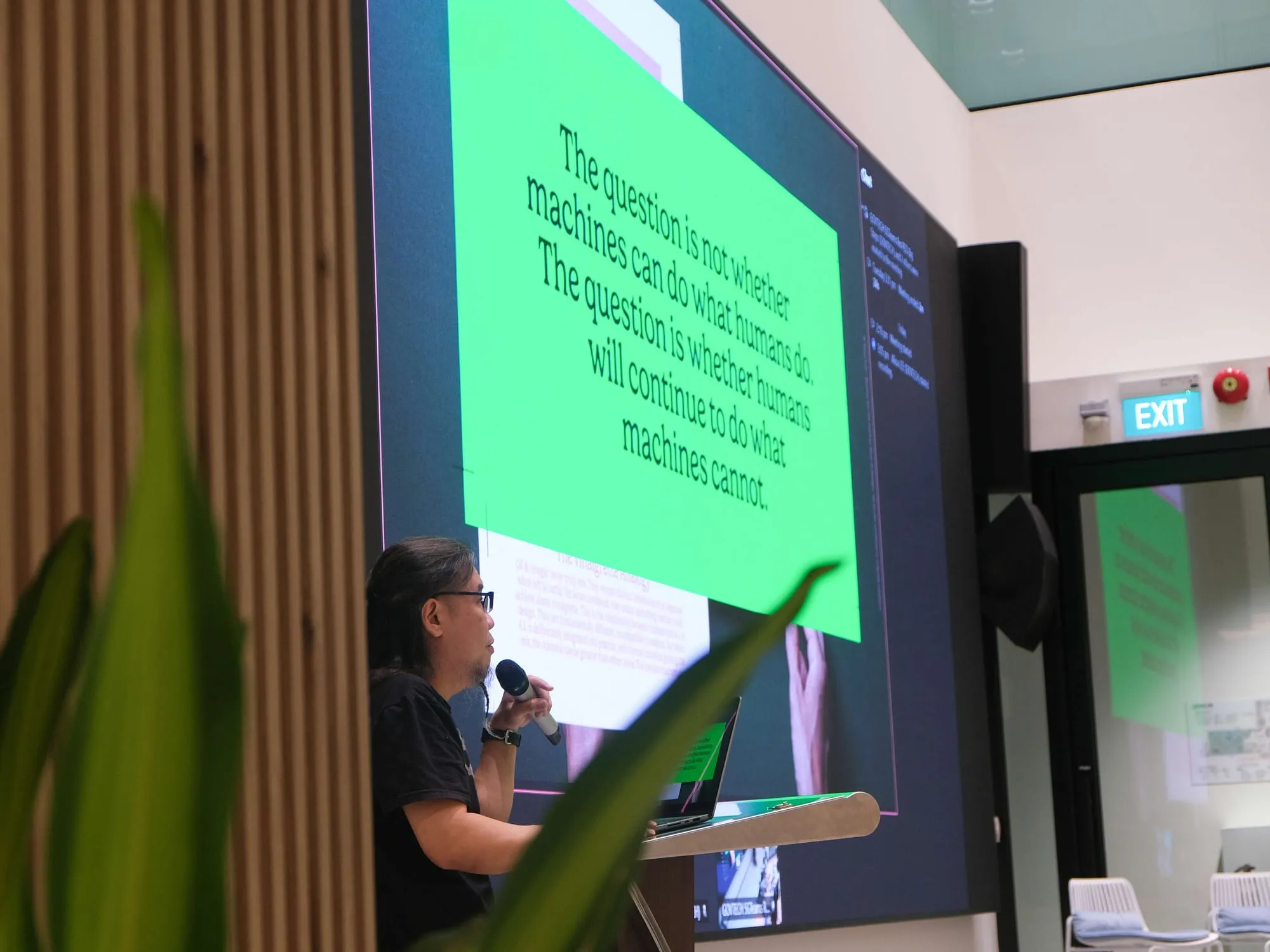
“The question is not whether machines can do what humans do. The question is whether humans will continue to do what machines cannot” - Pann Lim, Co-founder and Creative Director at Kinetic.
Good Enough is Not Enough.
Section titled “Good Enough is Not Enough.”The human soul may remain the heart of design and craft, but careers are built in a market, and the market doesn’t always pay for the soul. Pann is frank about this: a lot of AI work is “good enough” for clients… and at a fraction of the budget. But “good enough” is not the same as distinctive, trusted, or impactful, especially for work that requires judgement, accountability and deep contextual understanding.
So what keeps a designer irreplaceable?
Not Extinct, Just Distinct.
Section titled “Not Extinct, Just Distinct.”For now, Pann’s answer is to raise the bar and to be distinct enough to be relevant. AI will only improve, and mediocre work will soon be indistinguishable from a generator’s. As Pann puts it,
“If your work looks like it has been done by AI, the problem is not the tech.
The problem is your own work.”
Human work, he says, must carry the unmistakable signature of a human soul: gutsy, creative, emotionally charged, culturally resonant and conceptually sharp. Look closely and the list reads like the 11 dimensions at work.
Grow the Eye, Not Just the Prompt.
Section titled “Grow the Eye, Not Just the Prompt.”The bar rises for young and older designers alike but not evenly. Pann can judge AI output because he spent years building his eye. Juniors haven’t had that time. They can prompt all day but without taste, they can’t separate the brilliant from the banal. This also doesn’t mean that the answer is to learn how to prompt better either. It’s to learn how to see better.
Juniors need time and room to build taste and seniors are the ones who should make that room for growth.
GovTechies listening to Pann share his thoughts on the direction of design.
Conclusion: Is this the end?
Section titled “Conclusion: Is this the end?”So, will our roles still be relevant? Pann doesn’t promise that every role will remain unchanged. Some roles may evolve significantly while new skills and new forms of work will emerge. But AI will never replace the human soul and his answer points the way for all of us, whether we design, build or ship. Instead of defaulting to AI out of habit, raise the bar so your work could never be mistaken for a machine’s.
What happens if we don’t? Pann wrote a eulogy for the human soul of design, not because he believes it’s gone, but to show what we could lose:
Images from Pann Lim, via @pannlim on Instagram
So, is this the end? Only if we let it be.
Thank you Pann Lim for your generosity, candid insights, and for staying well past the scheduled time to answer every single question from the audience.
About our speaker

Pann Lim
Co-Founder and Creative Director, Kinetic Singapore
Pann Lim has been guided for nearly three decades by the belief that design without an idea is a sin.
He has won over 550 awards, including Gold Pencils at The One Show (opens in a new tab), a Yellow Pencil (opens in a new tab) at D&AD, and four President’s Design Awards (opens in a new tab), Singapore’s highest design honour, among them Designer of the Year in 2013. He has served as Jury President at D&AD, Adfest and the Kancil Awards. In 2011 he founded HolyCrap, whose Rubbish Famzine series was acquired by the Singapore Art Museum. Pann continues to mentor young designers through talks and advisory roles at design schools.
About the event: This talk is part of a speaker series by Design Practice at GovTech.