Built for the Journey: Inside Inception
Introduction
Section titled “Introduction”Day one of a new initiative can feel like standing at the trailhead on a mountain-climbing expedition. You’re eager to reach the summit, but not without apprehension for the unknown challenges waiting up ahead. Perhaps you’re working on an exciting greenfield product, or navigating a modernisation challenge with a complex legacy and critical systems.
You also know that charging up the mountain with no preparation would mean certain disaster… So what steps do you take to ensure everyone in your expedition team is clear about the outcome, the plan, and how you will work together?
“How well do you know the people on your team?”
“Can you count on each other?”
“How will you support each other when things get tough?”
These are critical questions all product leaders should ask themselves even if they’re on a well-defined path with a familiar team. They’re also all part of Inception. Admittedly, these questions are harder to ask when the path carries a history—as so many do.
Inception: A (Re)Fresh Starting Point
Section titled “Inception: A (Re)Fresh Starting Point”During my first week at GovTech, I found myself preparing for such an expedition. The initiative was a transformation project where past teams had attempted the climb, only to turn back partway. “The system is too complex,” some would say. “The processes are too entrenched” or “The data is too critical”. For others, the mountain could not be summited at all. As a newly onboarded design leader, and without a product manager or engineering lead in place, I had been asked to explore: how do we approach this legacy system with a “zero-based” mindset?
As I began talking to previous project team members, I saw immediately that, although the system and domain were indeed extremely complex, the larger challenge to overcome would be repairing a broken working culture and working environment. It was at that time that we were introduced to Inception, a team kickoff workshop, crafted by the Digital Excellence & Product Division (DXD) team at the Ministry of Education.
We found that this existing framework did well in addressing Product (the problem and vision). However, in our case where the initiative had inherited a history of delivery fatigue and cautious momentum, strengthening the Process of delivery and People (team culture) became essential. We wanted to further cultivate a safe working environment—a space where we could learn, challenge ourselves, and move from simply delivering to delivering outstanding results. And so, we set out to re-design Inception for our purposes with three objectives in mind:
-
Expand Inception to drive alignment on all three pillars that are the foundations of a successful product team:
- Product: What are we trying to accomplish and why?
- Process: How will we work together to succeed?
- People: Who are we as a team? What is our culture?
Note: Here, Product refers to the shared outcome that teams are bringing to life. Inception can also be used to kick off projects and programmes.
-
Ensure that Inception doesn’t end after a kickoff workshop, but is an ongoing Practice (the fourth pillar) with rituals that maintain and grow team culture and clarity throughout the lifecycle of the team.
-
Build Inception into a repeatable system that any team can use when starting.
Building Resilience as the Team’s Base
Section titled “Building Resilience as the Team’s Base”High-performing teams emerge when there is strong alignment on Product, Process and People, and are sustained through Practice: “What habits will we carry throughout the initiative to ensure we stay aligned along the way?”
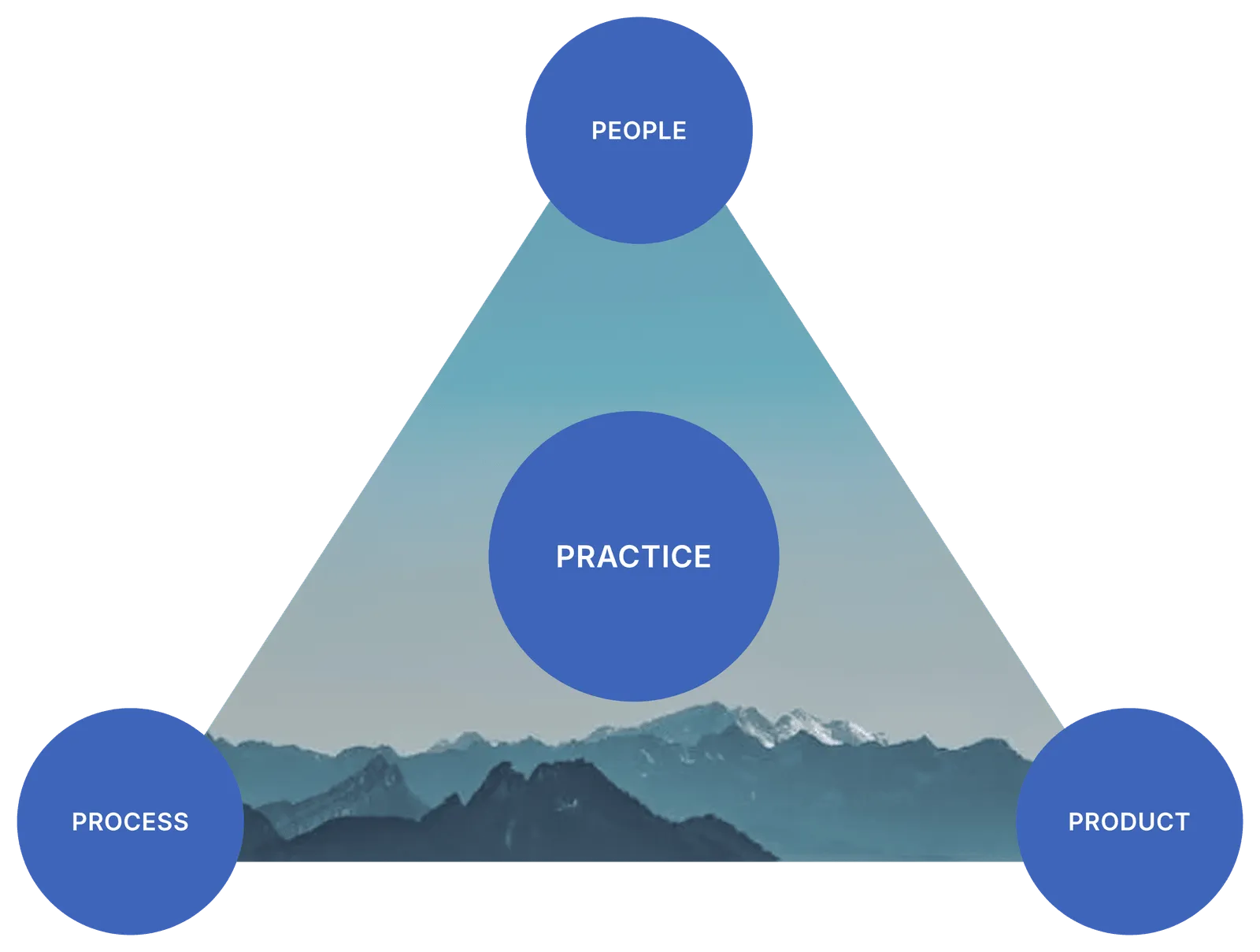
“Great products are built by great teams”. Diagram of all four pillars where Practice maintains alignment on Product, Process, People. Image taken from the Inception Playbook.
When we kicked off our Inception, Process and the Product vision were reasonably well established. Both are typically developed and shared top down (though both can evolve as we experienced over the next few months of Discovery). However, team culture, the rituals and expectations that form an effective, safe team dynamic, cannot simply be briefed. They must be built through direct experience and created by the team. The Inception Workshop helps to establish and reinforce these foundations through a deliberate, structured experience.
In the context of a mountain expedition, the Inception Workshop serves as a basecamp. It’s the space where teams acclimatise, align on routes, and pressure-test routines before the ascent begins. Teams that rush through this stage rarely survive unexpected challenges higher up the mountain. Those that treat the basecamp as a foundation build the resilience required to reach the summit.
Inception and the Workshop, Explained.
Section titled “Inception and the Workshop, Explained.”The Inception Workshop serves to align the team around Product and Process, but with a primary focus on the team culture (People), introducing the supporting Practices that will continue through delivery.
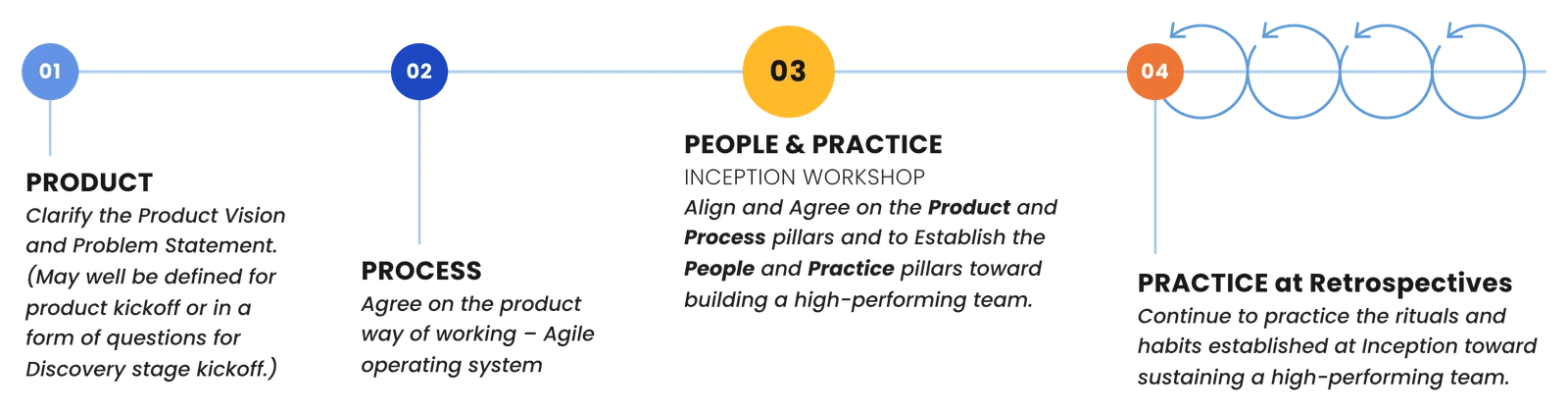
Full lifecycle of the re-designed Inception process. Image taken from the Inception Playbook.
Before the Workshop: Establishing a Foundation for Success
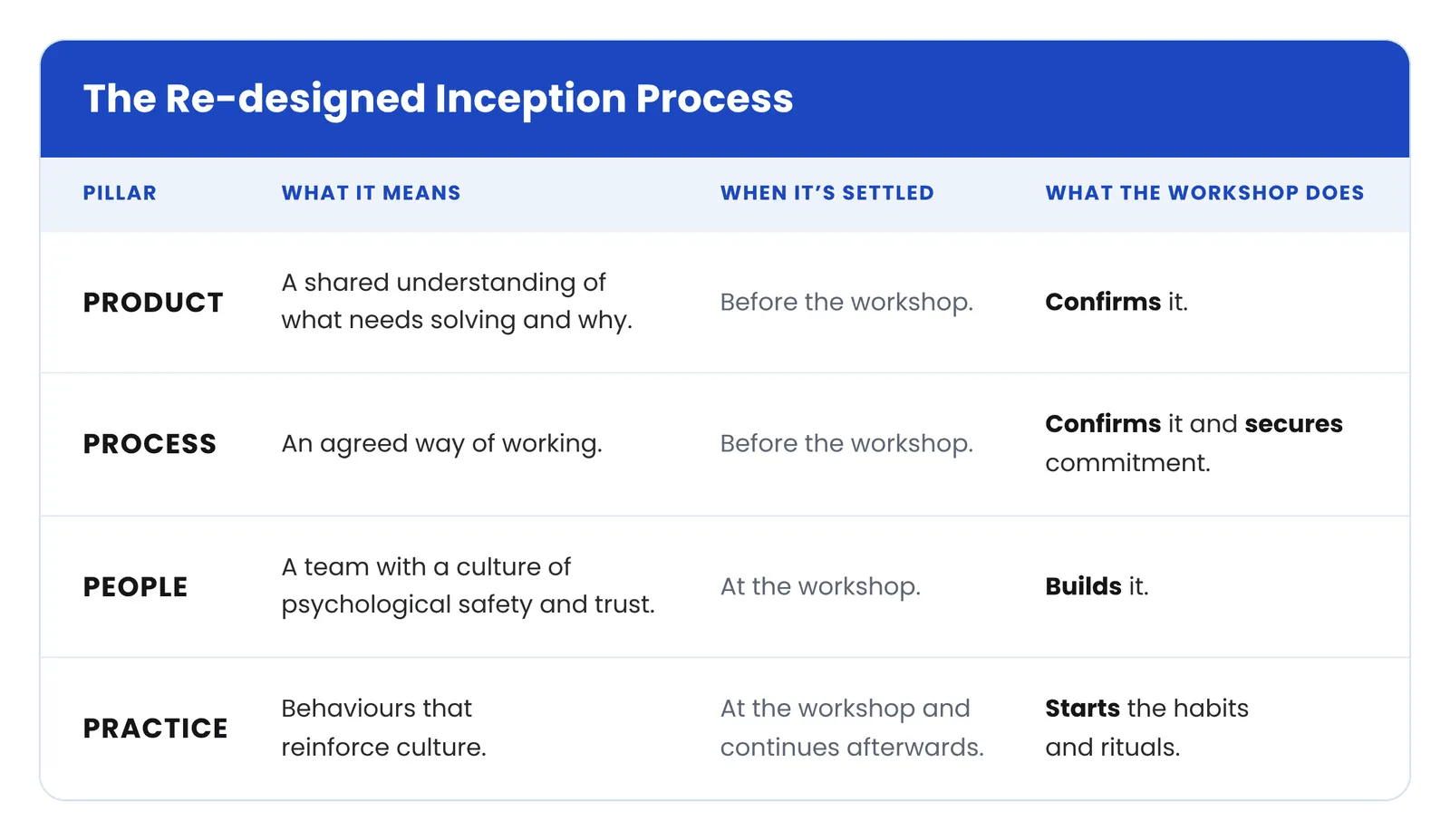
Section titled “Before the Workshop: Establishing a Foundation for Success”The workshop can confirm and sharpen Product and Process, but it is not the place to define them. Before entering the workshop, teams should have the following in place:
1. Clarity on the Product
Section titled “1. Clarity on the Product”The team should already know what they hope to achieve, what needs solving and why. This is probably obvious—if there was no proposition, there would be no initiative to kick off. Inception gives the team time and space to re-focus on the Product vision and outcomes we are trying to achieve. If this is in contention, a separate session dedicated to hashing out the differences may be needed.
- If starting on a new initiative: the Product understanding can be a statement of the problem space, a high-level vision for the future, or an initial idea of the questions to be explored in Discovery.
- If evolving on an established initiative: the Product understanding could include more clarity about users, problems, constraints, and history.
2. Consensus on the Process
Section titled “2. Consensus on the Process”The team should at least have an initial agreement on roles and responsibilities, the delivery approach, and a high-level plan.
Inception assumes a product way of working and an agile operating model. If team members are new to agile or unaligned on an agreed approach, it may be necessary to run a training separately, before Inception.
Inside the Workshop: The Four Pillars
Section titled “Inside the Workshop: The Four Pillars”Product Pillar
As mentioned earlier, the Inception Workshop is not where the product vision is created; it’s there to ensure that everyone in the room can articulate what the team is building, why, and for whom.
The facilitator should walk the team through the product vision and problem statement, invite questions, and surface any gaps or misalignments before they become problems mid-project. Useful activities include problem statement exercises (e.g. 5 Whys), Jobs To Be Done discussions, and product vision walkthroughs.
Process Pillar
The Product pillar generally assumes a product way of working and an agile operating model. Because agile requires active engagement across the whole team (you cannot have a passive product owner who simply asks for increments), the team needs to be genuinely aligned on the process, not just informed of it.
The facilitator’s job is to walk through the agreed ways of working, covering sprint cadence, ceremonies, roles, and backlog management. The Inception workshop is not an agile training session. If members of the team are new to agile, training should happen separately from Inception. The goal is commitment: by the end of this pillar, the team should be able to say, “Yes, this is how we will work.”
People Pillar
Unlike Product and Process, People is not a single alignment exercise; it’s a carefully sequenced set of experiences. The order in which the activities run is deliberate: each one builds on the previous, gradually preparing the team for psychological safety and self-facilitation. Do consider carefully before rearranging the sequence.
There are two goals in the People Pillar:
Goal 1: Building Openness
Psychological safety relies on openness, which takes time. To safely build openness, the workshop builds trust through the Openness and Trust Spiral, a model by Anders Wendelheim, where opening up bit by bit creates the safety needed for deeper collaboration.
| 01 | Stand & Share | Gets participants talking about a great team they’ve observed or been part of. It’s a comfortable exercise that gets them used to talking to each other without personal exposure. |
| 02 | Roles & Rules | Clarifies everyone’s role and the ground rules for the workshop, setting the expectation of openness and trust in the process. |
| 03 | Common Connection | Participants look for things they have in common. This raises the stakes slightly: they now need to talk about themselves. |
| 04 | Helpful & Hindering Behaviour | The team names behaviours that help or hinder good team work. This surfaces themes of openness, active listening, and psychological safety—named by the participants themselves, not imposed by the facilitator. |
| 05 | Deep Self-Disclosure | Two options are offered here, so you can choose the one that works best for your situation:
|
Goal 2: Owning Self-Facilitation
These same activities also serve a second goal by shifting ownership from the front of the room to the group. Each activity progressively removes facilitator scaffolding, training participants to manage their own team dynamics:
| The team manages their own basic timekeeping and turn-taking around neutral, low-pressure topics. |
| Team members take over topic transitions and decide when to speak, shifting from structured rounds to self-regulated dialogue. |
| Quiet reflection ensures every individual contributes ideas upfront, creating a structured handoff where participants—rather than the facilitator—begin guiding the group’s selection process. |
By the time the team has reached Personal Presentations or Motivation Assessment, they should be self-facilitating the session—balancing airtime and holding space for one another. To close, an optional Appreciation Cocktail exercise reinforces the team dynamic with an entirely peer-driven exchange of feedback and recognition.
Practice Pillar
The goal is to leave Inception not just with agreements on paper, but with muscle memory.
Throughout the workshop, the activities serve as the team’s initial rituals—embedding habits of open communication, shared ownership, and constructive engagement. Closing the session with a dedicated ceremony, such as a retrospective, solidifies these practices into a repeatable rhythm. Experiencing the team’s dynamic firsthand before high-stakes project execution gives the team a lived benchmark and a cultural foundation that Product Leads should actively protect and sustain far beyond the workshop.
After the workshop
Section titled “After the workshop”High-performing teams are built on Inception, but Inception is not a one-time event. By the end of the workshop, teams will have had the chance to build their Practice. But these rituals—checking in, setting a cadence for interaction, surfacing problems early, staying aligned on Product, Process, and People—are only valuable if they are carried into sprint after sprint.
One simple but powerful practice that can help teams monitor and adapt as the work progresses is the Focus Plate exercise. Team members vote on how they currently feel about Product, Process and People. This can be done by secret ballot with notes describing what is working or not working or, as team trust grows, by an open thumbs-up, -down, or -sideways vote. The session facilitator can open up discussion or, if there are issues that people don’t feel comfortable discussing, suggest a safe alternative. This does several things at once:
- Tracks team trends and identifies areas that need attention, while also creating a shared sense of where the team is as a whole (beyond any one individual’s view).
- Helps keep issues from festering by bringing them out into the open and ensures no one is left behind.
- Creates a shared foundation for action so that pivots or escalations don’t come as a surprise.
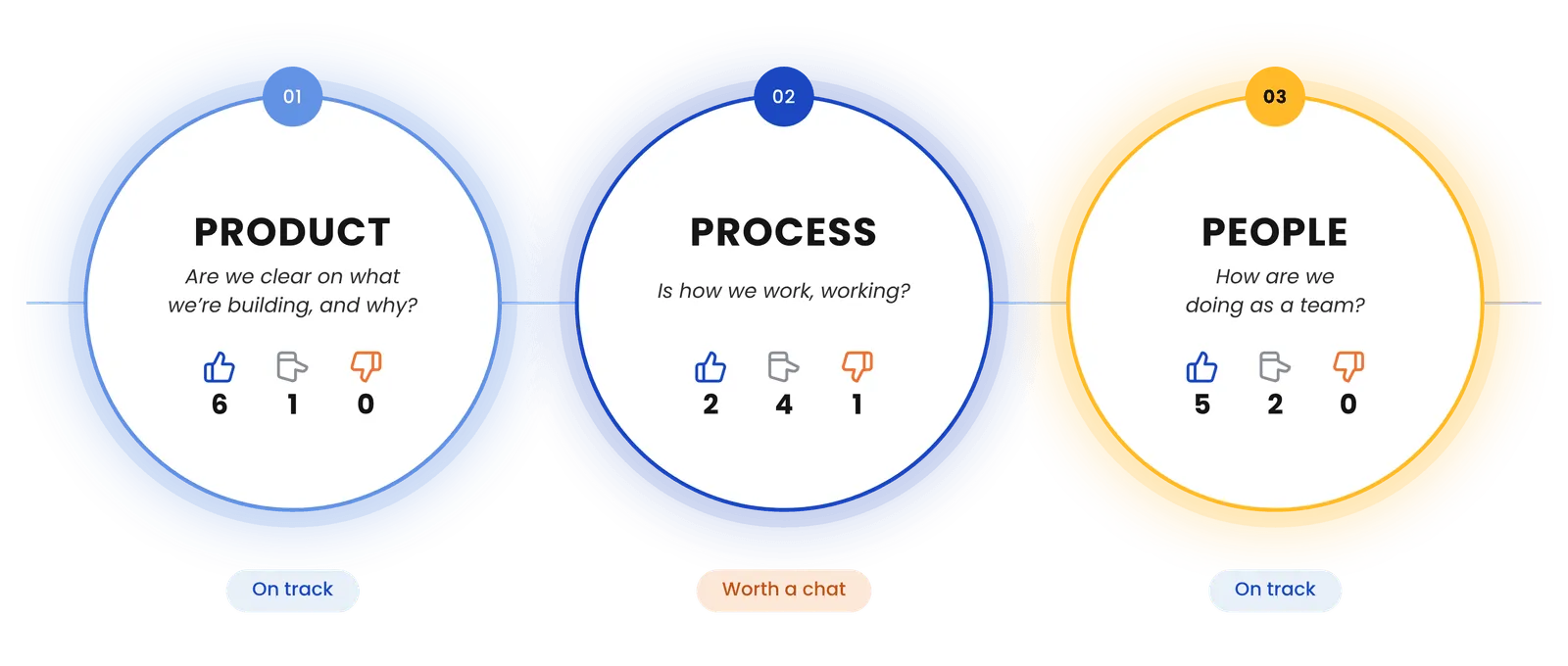
Example results of the Focus Plate exercise from a team of seven. At each check-in, everyone votes on how they feel about Product, Process, and People. Use this exercise to spot trends, catch issues early, and to act together.
Through this simple type of sharing, teams learn that raising issues is welcomed—not punished—and see that they can rely on one another. This can powerfully grow team trust, deepen culture and build positive habits that can extend even beyond the immediate team.
Running Your Own Inception
Section titled “Running Your Own Inception”So how can you put Inception into action for your team? For most teams, this will be a self-run process. Given the existing team dynamics, we chose to bring in an external facilitator for a fresh, objective perspective. Internally, we’ve captured the full workshop in an Inception Playbook, made available only to public officers for now. However, wherever you work, the principles behind Inception can work for any team:
- Treat the pillars as a starting point, not a fixed script. Emphasise, adapt or compress them to fit your product and team.
- Keep the People’s activities in order, so openness builds step by step.
- Hand ownership to the team gradually, so they can run their own check-ins after the workshop.
Inception is a living process that improves with every run. We would love to see more teams adopting Inception and hear how these practices work for you.
Good luck on your next expedition!